The Alliance to End Plastic Waste, the industry’s $1.5 billion effort to make a dent on ocean pollution, doesn’t see much cause for optimism about tackling the problem anytime soon.
“When you look at the plastics waste situation globally today, the picture is bad and it’s getting worse,” said Justin Wood, vice president of strategic partnerships for the alliance. “We have a very bad situation today and when you look at the future, the outlook is for it to get significantly worse.”
Wood spoke on a virtual panel March 3 at the World Ocean Summit, where he said growing global population and an expanding middle class will lead to more plastic use.
Citing studies, he told the forum that plastic production is expected to double by 2040, but with much of the new use coming in countries without the infrastructure to control that waste well, the amount of plastic in the ocean will triple in the same period, Wood said.
Those aren’t new conclusions in the waste debate, but it was a sober message coming from a senior executive in the alliance, which was launched by plastics and consumer goods firms two years ago to try to finance solutions in developing countries.
Wood said it’s not all about waste management in developing countries, though. He called on global consumer goods companies to strengthen previous commitments to use more recycled plastic.
The alliance analyzed pledges from consumer goods makers who have committed to use a lot more recycled plastic in the next few years, but Wood said they found most aren’t going to meet those promises.
“By 2025, the sample of consumer goods companies were pledging to have one-quarter of their packaging made from recycled materials,” Wood said. “Today, it’s only 2 percent of their packaging. There’s a gap of 23 percent that needs to be closed in 4.5 years. … There’s just no way that’s going to happen.
“The pledges don’t go far enough, but even the pledges that have been made are likely to be unmet,” he said.
A report from the Pew Charitable Trust in 2020, Breaking the Plastic Wave, estimated that all of the major business and government commitments to reduce plastic waste would only shrink flows into the ocean by 7 percent annually by 2040.
Similarly, an executive from Kraft Heinz Co. told the conference, organized by The Economist magazine, that the current plastics pledges don’t seem like they’ll be enough.
“I will have to agree, the current commitments are not enough for us to get where we need to get to by 2040, 2050,” said Jojo de Noronha, Northern Europe president for Kraft Heinz. “You need to start with very, very stark changes.”
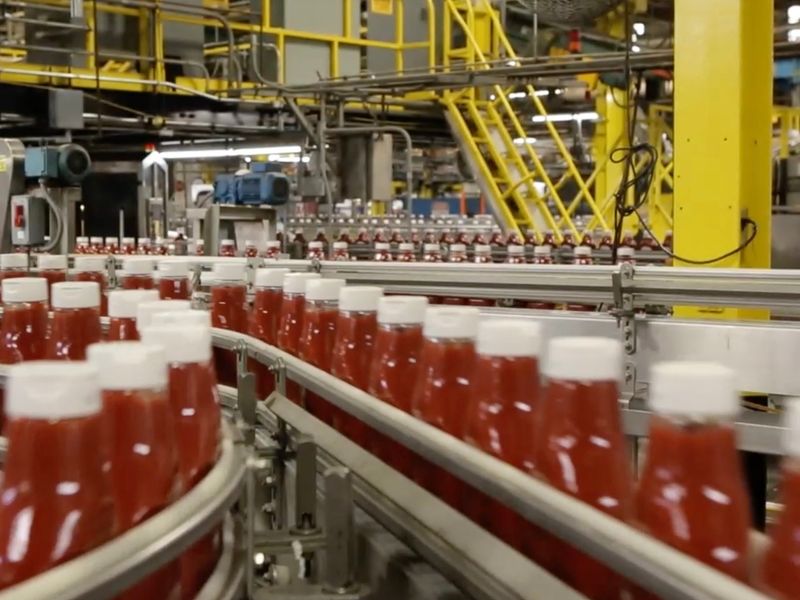
As a start, she said, her company removed all secondary plastic packaging from its products in Northern Europe this year and is moving to use at least 30 percent recycled PET in its ketchup and sauce bottles.
Martin Stuchtey, managing partner of consultancy Systemiq Ltd., said many different solutions will be needed, including extended producer responsibility programs and having companies like Kraft Heinz sign long-term contracts to buy recycled materials to provide stability to finance recycling investments. He suggested a series of “leap of faith” compromises for NGOs, industries and government. His firm coauthored the Pew report.
“What if we were to accept that some products have to be delisted altogether; that’s a leap of faith for those who are using those hard-to-recycle materials,” he said. “There’s also a leap of faith for some of the NGOs, which want to get rid of plastics altogether.”
An environmental group speaking at the summit, Oceana, took issue with Stuchtey over his statement that NGOs want to ban all plastics, saying it distorted their concerns.
“I work with some of the most radical environmentalists out there, and nobody is saying that,” said Jacqueline Savitz, Oceana’s chief policy officer for North America. “There’s a lot of recognition that there are necessary plastics, especially for medical uses. Let’s not paint the NGO community as being unreasonable.
“What we want to do is avoid the use of unnecessary plastics,” she said, pointing to business models like refillable packaging.
She also criticized what she called the vagueness of some industry commitments “like promises to collect all bottles by some year far in the future.”
“You have to take a huge leap of faith to believe that that’s going to happen,” Savitz said. “Those sorts of promises really distract attention away from the real solutions, which is to reduce the waste at the source by reducing the plastic that we’re using.”
Various panels at the summit also delved into structural challenges, like price gaps between virgin and recycled resin, that can be a disincentive for recycled materials.
On the other side, they looked at potential economic advantages for companies, if a solid supply chain could be built for recycled plastic.
“That’s the same argument we make in the renewable energy space,” Stuchtey said. “A well-funded recovery, recycling and waste economy is a very good proposition for businesses.”
Stable prices for recycled materials to counter volatility in virgin markets is “good news to a [chief financial officer],” Stuchtey said.
Wood said building waste management infrastructure is a key barrier, and he said AEPW is making progress.
“That’s one of the areas where our organization is investing very heavily,” he said. But he added it would also require government involvement in things like extended producer responsibility programs to help close the price gap between recycled and virgin resin.
“It does require legislation, I think, and regulations from government to also put in place EPR schemes,” Wood said.
An executive from Dow Inc. told the conference that while plastics often have a better carbon footprint than other materials, the end-of-life impacts like waste have too often been neglected.
“Plastics have been designed over the last couple of decades predominantly with the focus to use the least amount of resources and materials and optimize the CO2 savings whilst maintaining that functionality,” said Marco ten Bruggencate, commercial vice president of packaging and specialty plastics for Europe, the Middle East and Africa for Dow. “What we forgot in the process is the actual end of life.”
He urged governments to require recycled content to improve the economics for waste management.
“Unless we get mandatory recycled content, which will drive a lot of the economics in the whole circle and the chain, this will not become a reality,” ten Bruggencate said. “It’s not just about making it recyclable, but having the overall policies and everything in place to make it a reality.”
Stuchtey predicted packaging investment will start to shift. More resources will go into other delivery models, in using more recycled plastic in packaging, or in finding other materials that can provide the same benefits to consumers as the single-use, virgin plastic packaging model today, he said.
“Dematerializing or reducing what is plastic today is part of the solution, and if you look at it as industry, or if you look at as an investor, that’s not the end of the world,” he said. “You just want to be invested in the right wedges.”
AEPW sees plastic waste situation ‘bad and getting worse’
A summit on problems facing the world’s oceans took a deep look at plastics, with panelists from business groups, environmentalists and consultants urging some rethinking around how plastics are used in packaging.
This post appeared first on Plastics News.