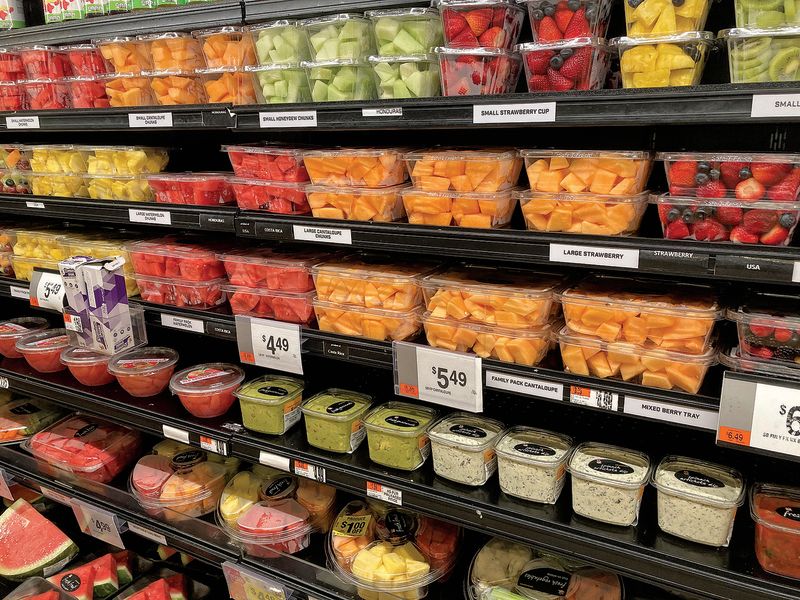
PET thermoformed packages like clamshells for berries and deli sandwiches are all over grocery stores. But only 9 percent of them ever make their way to recycling bins.
It’s a problem vexing those trying to create a more circular supply chain for the popular packaging material.
“My biggest obstacle since we started a couple years ago has been collection,” said Octavio Victal, CEO of PET thermoform recycling company Green Impact Plastics SA de CV, which has factories in Vernon, Calif., and Juarez, Mexico.
Those challenges, however, are getting a lot more attention, both from fresh produce companies trying to green up their packaging and from state lawmakers disturbed that so few of them are recycled.
Berry and vegetable suppliers like Driscoll’s and Ready Pac Foods Inc., for example, say they plan to use more recycled PET in clamshells, although those companies also point to problems getting enough material.
“We are faced with a challenge where communities are not currently collecting thermoform containers enough to support adequate recycling rates and supply,” said Scott Wilkerson, chief procurement officer at Bonduelle Fresh Americas, which sells under the Ready Pac brand.
To address that shortage, state lawmakers in California are considering new legislation they see as boosting the market.
Building on a law they passed last year mandating high levels of recycled content in plastic beverage bottles, they’re considering a new bill that would require recycled content in thermoformed cups, clamshells and other packaging. They see it as a way to create economic incentives for local recycling programs to collect more.
“We’re all led to believe that these are recyclable items when almost none of these items are ever recycled,” said Assembly Member Philip Ting, D-San Francisco, the lead author of the measure. “We think that building on our bill from last year … we can really move the market and create a circular economy for this.”
Ting’s bill would require thermoform packaging to have 10 percent recycled content by 2024, 20 percent by 2027 and 30 percent by 2030.
Victal sees interest growing in recycling thermoforms, both from the legislative proposals and from the produce industry.
Berry seller Driscoll’s, for example, in March joined the Ellen MacArthur Foundation’s New Plastics Economy project and said one of its goals would be using more material from recycled PET clamshells in its packaging.
“Thermoforms have picked up a lot of interest in the last two years, especially with the legislation in California,” said Victal, who also pointed to early stage legislation in Texas.
He believes there’s a lot of potential investment waiting to happen, if supply problems can be solved.
“There’s a lot of opportunity right now to invest because there’s private equity, there’s the Closed Loop Fund, there’s a lot of financing tools out there, but the problem remains supply — good consistent supply,” he said.
Others in the packaging chain are studying the problem.
A coalition of packaging and plastic industry groups released a report in December on pathways to try to increase PET thermoform recycling.
The report included the first calculation of a recycling rate for PET thermoform packaging, at 9 percent, said Resa Dimino, a senior consultant at Resource Recovery Systems, which prepared the report for the industry coalition.
The report estimated there’s 1.6 billion pounds of PET thermoforms used in packaging in the United States and Canada annually, which it said is sufficient to sustain a recycling market. That’s about same size as the market for high density polyethylene natural resin grades used in milk and other bottles, it noted.
However, it also found sizable barriers.
Dimino said they include some technical challenges that cap the amount of PET thermoforms that can be mixed in with bales of more valuable PET bottle material at about 10 percent, or the thermoforms can start to be a contaminant.
There are also economic hurdles. The report said low virgin resin prices in the last few years have created a “competitive challenge.”
As well, Dimino said that while buyers of bottle-grade recycled PET are willing to pay a price premium, that’s not true in other markets, like thermoforms.
“There are limited end markets that can broadly accept those recycled PET thermoform materials due to some of the constraints … mechanical and otherwise,” Dimino said in a presentation at the SPC Impact 2021 conference in April, an online event sponsored by the Sustainable Packaging Coalition.
Another big hurdle: The materials recovery facilities that process curbside recycling need more consistent markets and pricing signals for thermoforms, she said.
The message from MRFs contacted for the report is “if you want us to sort it, we can sort it, but we need those consistent markets,” she said.
Like some other less developed recycling markets, PET thermoform markets were hit hard by China’s 2018 National Sword limits on scrap plastic imports, especially in West Coast cities that relied heavily on exports, Dimino said.
“The biggest shockwave was the inability to move these low-value PET thermoform bales out of California,” she said. “There was a real challenge for quite a while.”
But she believes there are signs the market is adjusting, with domestic U.S. demand for the thermoform material starting to emerge. She pointed to several active buyers in California.
“We’re getting more and more separation of those thermoform-only bales in California than we’ve ever seen before,” Dimino said. “We’ve seen domestic markets come up and fill that gap. It just took a little while to get through that process.”
The PET thermoform report is part of a project led by the Foodservice Packaging Institute, and it includes the Association of Plastic Recyclers, the National Association for PET Container Resources and companies like Amcor Ltd., Driscoll’s, Eastman Chemical Co. and Sonoco Plastics.
Dimino said the next phase will be to develop a pilot project in a community and work with MRFs and others on technical challenges, and then try to develop a viable investment strategy for PET thermoform recycling, similar to ongoing work with the Polypropylene Recycling Coalition.
Some recycling and produce companies are saying that more market demand is needed and are supporting the California legislation, known as Assembly Bill 478.
PET recycler and packaging maker rPlanet Earth in Vernon, Calif., testified in support of Ting’s legislation, saying it will help create a closed-loop system where PET thermoforms can be more readily recycled back into new PET thermoforms.
“[This bill] will create market demand for material that for the most part is being landfilled,” said Robert Daviduk, co-CEO of the company. “Manufacturing needs stability, which is why AB-478 is needed in order to provide market demand and to incentive collection of raw material feedstock.”
He estimated that California produces about 200 million pounds of PET thermoform packaging a year and another 150 million pounds of polypropylene thermoform packaging.
Bonduelle, in Irwindale, Calif., also said it was supporting the legislation, arguing that it would support the company’s investments in recycled PET in packaging for prepared salads and produce.
Clamshells play an important role in allowing companies in California, the country’s largest agricultural producer, to safely ship products, Bonduelle’s Wilkerson said.
“Thermoform packaging such as clamshells have revolutionized the ability of California farmers to transport their fresh produce to consumers nationwide,” he said. “This type of packaging helps extend product life and protect the produce from damage and contamination.”
But the company, which is part of the French firm Bonduelle Group, wants to use more recycled content and needs more supply.
Wilkerson said last year’s plastic bottle recycled content law in California is already adding to shortages.
“This bill will propel the whole supply chain toward more environmentally responsible packaging,” he said.
The Plastics Industry Association, however, said it opposed the legislation.
The Washington-based group said recycled content mandates can be positive but it is opposing Ting’s bill and urged California to work on boosting supplies of recycled plastic before mandating content.
“There still exists a significant gap between how much recycled content exists and the requirements of this bill,” said Shannon Crawford, director of state government affairs. “While this bill would develop end markets for plastic materials, there should be an equal emphasis on improving the collection and sortation of these materials.”
She urged the state to look at secondary sorting facilities like one the association helped fund in a trial in Oregon in 2020, saying that it demonstrated that such advanced sortation plants can pull out more recyclables.
But the economics of those facilities are also not clear. The Foodservice Packaging Institute report said such secondary plastics sortation were “the least clear route to success” for increased PET thermoform recycling.
One California lawmaker who supports the bill called the content mandates an important step in creating markets and addressing what he said are misleading messages to consumers “that so much of their plastic … goes to some magic place and it’s going to be recycled.”
“I think there’s been this fraud put upon the consumers for the past two decades, believing that you put everything in the blue bin and it’s all good,” said Assembly Member Kevin McCarty, D-Sacramento. “That’s not the case. We need to have a reality check.”
This post appeared first on Plastics News.